









Federal Fair Housing Laws PDF Print E-mail
Written by FairHousing.net   
Wednesday, 15 April 2009 20:32
Protect you from housing discrimination on the basis of:

Race, Color, National Origin, Sex, Disability, Families with Children or Pregnancy.

CIVIL RIGHTS ACT of 1866: The first federal housing law, provides that all citizens shall have the same right as white persons to purchase and lease real estate and personal property. In 1968, the United States Supreme Court interpreted this statute to apply to all real estate transactions, private as well as public, thereby greatly expanding the legal remedies available to victims of housing discrimination. Provides protection to non-whites and Hispanic-Americans by court interpretations.

TITLE VI of the CIVIL RIGHTS ACT of 1968: The primary federal law which prohibits discrimination in the sale, rental, lease or negotiation for property on the basis of race, color, religion, sex, or national origin. Exclusions include owner-occupied boarding houses with more than three units and non-commercial lodging. This law mandates that the Department of Housing and Urban Development (HUD) administer its program in a manner that will affirmatively further fair housing. Administrative complaints may be filed with HUD.

Housing and Community Development Act of 1974: Prohibits discrimination on the basis of race, color, national origin and sex in federally-assisted community development activities.

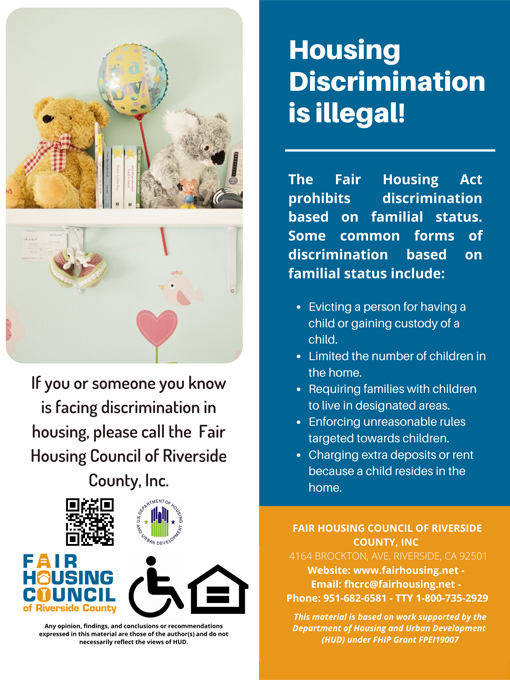
THE FAIR HOUSING AMENDMENTS ACT of 1988: The most dramatic and significant improvement in civil rights law since 1968. Effective March 1989 it provides federal protection against housing discrimination for the additional categories of the disabled and families with children under 18. It also provides HUD with the authority to initiate enforcement actions and to seek stiffer fines and penalties against individuals, businesses or organizations that discriminate in the sale, rental, or financing of housing.

Fair Housing Act (FHA) Fair Housing Act Regulations: The Fair Housing Act of 1968, as amended, 42 U.S.C. § 3601, et seq. ("FHA"), prohibits illegal discrimination in all types of housing transactions including all aspects of residential real estate-related transactions, including, but not limited to: the making or purchasing of loans to purchase, construct, improve, repair, or maintain a dwelling; a loan secured with residential real estate, such as a home equity loan, and the selling, brokering, or appraising of residential real estate.

The FHA prohibits discrimination based on: race or color; national origin; religion; sex; familial status; and disability.

HUD's regulations implementing the FHA are found at 24 C.F.R. Parts 100 and 103.

HUD and DOJ have principal enforcement authority under the FHA. The banking agencies must notify HUD when they have a reason to believe that there has been an isolated violation of the FHA and must notify DOJ if a pattern or practice is indicated. The OCC, OTS, FDIC and FRB also may take administrative enforcement actions for violations of the FHA.

Equal Credit Opportunity Act (ECOA) Regulation B: The Equal Credit Opportunity Act of 1972, as amended, 15 U.S.C. § 1691, et seq. ("ECOA"), prohibits discrimination on a prohibited basis in any aspect of a credit transaction. The ECOA is not limited to consumer loans. It applies to any extension of credit, including to small businesses, corporations, trusts, and partnerships.

The ECOA prohibits discrimination based on: race or color; religion; national origin; sex; marital status; age (provided the applicant has the capacity to contract); the applicant's receipt of income derived from any public assistance program; and the applicant's exercise, in good faith, of any right under the Consumer Credit Protection Act.

The Federal Reserve Board's Regulation B, found at 12 C.F.R. Part 202, implements the ECOA. Regulation B describes lending acts and practices that are specifically prohibited, permitted, or required, Official interpretations of the regulation are found in Supplement 1 to 12 C.F.R. Part 202. Because both FHA and the ECOA apply to mortgage lending, lenders may not discriminate in mortgage lending based on any prohibited factors in either list.

The OCC, OTS, FDIC, FRB, NCUA and FTC have authority to enforce compliance with the Equal Credit Opportunity Act ("ECOA") and Regulation B with respect to entities they each regulate. The agencies must notify HUD if they have a reason to believe that there has been an isolated violation of the ECOA or Regulation B that also violates the FHA and must notify DOJ of any pattern or practice violation of ECOA or Regulation B.

Truth in Lending/Home Owners Protection Act HOEPA Regulation Z: The Truth in Lending Act, 15 U.S.C. § 1601 et seq. ("TILA"), requires all creditors to calculate and disclose, in a uniform manner, the total cost of credit expressed as a dollar amount and as an annual percentage rate ("APR"). The TILA mandates additional disclosures for loans secured by a consumer's home and provides for a "cooling off period", during which consumers may rescind certain transactions that involve their principal dwelling. Click Here for more information on amendments to Regulation Z and predatory lending practices.

Click here for a complete historical summary of Civil Rights and Federal Fair Housing Law.
Last Updated on Thursday, 16 April 2009 19:23
 
Copyright 2009 Fair Housing Council of Riverside County, Inc.